This article was written by Cloé Duc, assisted by AI (ChatGPT 4o) with the following method: drafting a testimony-type draft (available below), reformulation by AI, AI/human edits.
This year, I led a media education cycle with my 4th-grade students on the theme “My phone, my planet and I”, following the path proposed by Internet Sans Crainte from TRALALERE (resource here).
💡 Objective: to collectively understand the environmental impacts of digital technology and produce a small fanzine that students could take home, to open discussion with their families about their practices and equipment choices.
Until then, everything was going well…
The first three sessions: viewings, readings, discussions, collective work on a large “problems / impacts / improvement ideas” board.
Then came the writing session: formalizing what they had learned before the fanzine layout.
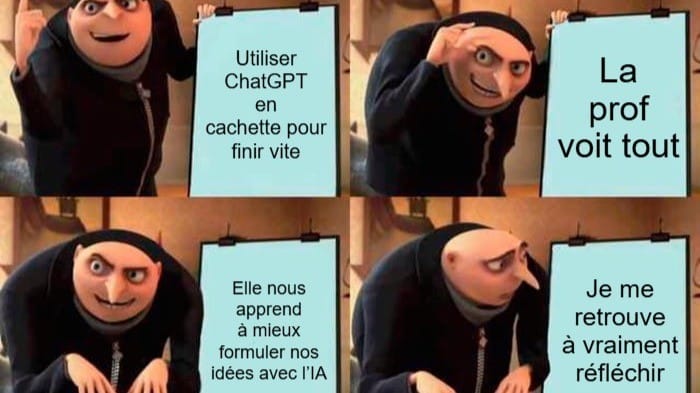
And then… in less than 5 minutes, half the group was already on ChatGPT, without asking, without warning. Not to do better, not to deepen… just to go fast, to “get the job done” effortlessly. A typical behavior: opening ChatGPT behind my back to cheat, hoping it would go under the radar.
Not a debate, not an exchange… just the reality of what’s happening in our classrooms today: AI is already here, whether we like it or not.
The pedagogical reality: wall or springboard?
I felt this moment very strongly:
Do I cut everything, do I go back to paper, even if it means alienating part of the group (and putting my dys students in difficulty)?
Do I go on a wild prompt hunt, tracking who copied what?
Or do I try to channel the energy where it already is?
I opted for the 3rd option. And since we had a test version of TokiChat on hand, I decided to make it a lever.
Not a miracle, but a real pedagogical shift
I framed the usage, accompanied the students in their first prompts, explained how to verify the generated information. It wasn’t perfect:
There was quick copy-pasting (detected, reworked),
There were silly AI-generated jokes (we’re still in 4th grade 😅),
But above all, there was a shift in attitude: moving from “I’ll quickly cheat” to “I’m using a tool to better express what I’ve understood”.
And, interestingly: some students who were totally disengaged from the activity, ready to botch the exercise by copying unrelated text snippets, regained interest in the task when the use of AI was authorized. They started looking for the right formulations, correcting the generated responses, thinking about how to present their ideas. Not all of them, obviously, but enough to make me see the difference in their engagement posture.
My observation as a teacher:
I didn’t anticipate this irruption of AI in the classroom. It caught me off guard, like many colleagues. But what I learned: ignoring or prohibiting it solves nothing. Framing it, on the other hand, puts meaning back into its use.
Initial prompt:
I want to write an article on LinkedIn to talk about my experience using AI in class.
I teach media education to a 4th-grade group. The theme is “My phone, my planet and I”, based on the path proposed by Internet Sans Crainte.
The first three hours consist of viewing, reading, and researching several resources, then co-constructing a large table with three columns: problems, impacts, and improvement ideas.
As I like my students to leave my classes with something concrete and tangible, I continued the process proposed by Internet Sans Crainte with a session to clean up what each student had learned, followed by a layout session in fanzine mode. The objective: for students to take this fanzine home to help their family choose their future smartphone.
I start my students on the first session: tidying up ideas and writing the texts for the notebook.
It didn’t take them five minutes for half the group to already be on ChatGPT — which I hadn’t anticipated. There, three options were available to me: turn off the computers and force them to do it on paper (which would cause a revolt, and not nice for the three dys students in the group), forbid ChatGPT and spend the rest of the sequence fighting to prevent them from using it, or accompany their practice.
I chose the third option: at the time, we were testing one of the first versions of TokiChat and I decided to open access for all students in the group.
I regain the group’s attention, give them the codes, specify that no one is obliged to use this tool (some still prefer to do things themselves), and I start going behind the computers to help them connect, then to give them advice to improve their prompting.
The shift was striking: before, students considered using ChatGPT as cheating; they did it secretly, without rereading anything, just to get the task done with that (delicious for a student) feeling of having managed to fool me and being smarter than me. Result: zero degree of involvement in the conversation with the AI.
By authorizing its use and framing it, the tool took on a completely different aspect in their eyes: that of an efficient assistant, to whom one can ask precise things, who can be truly useful… provided one gets involved in the exchange.
Of course, I had students who continued to do simple copy-pasting — those, easy to detect, I made them start over — and of course, they continued to use ChatGPT secretly to generate insulting poems and exchange them by email. But at least, they really worked on the subject, remobilizing the concepts seen together during previous sessions.
In short, it was great.