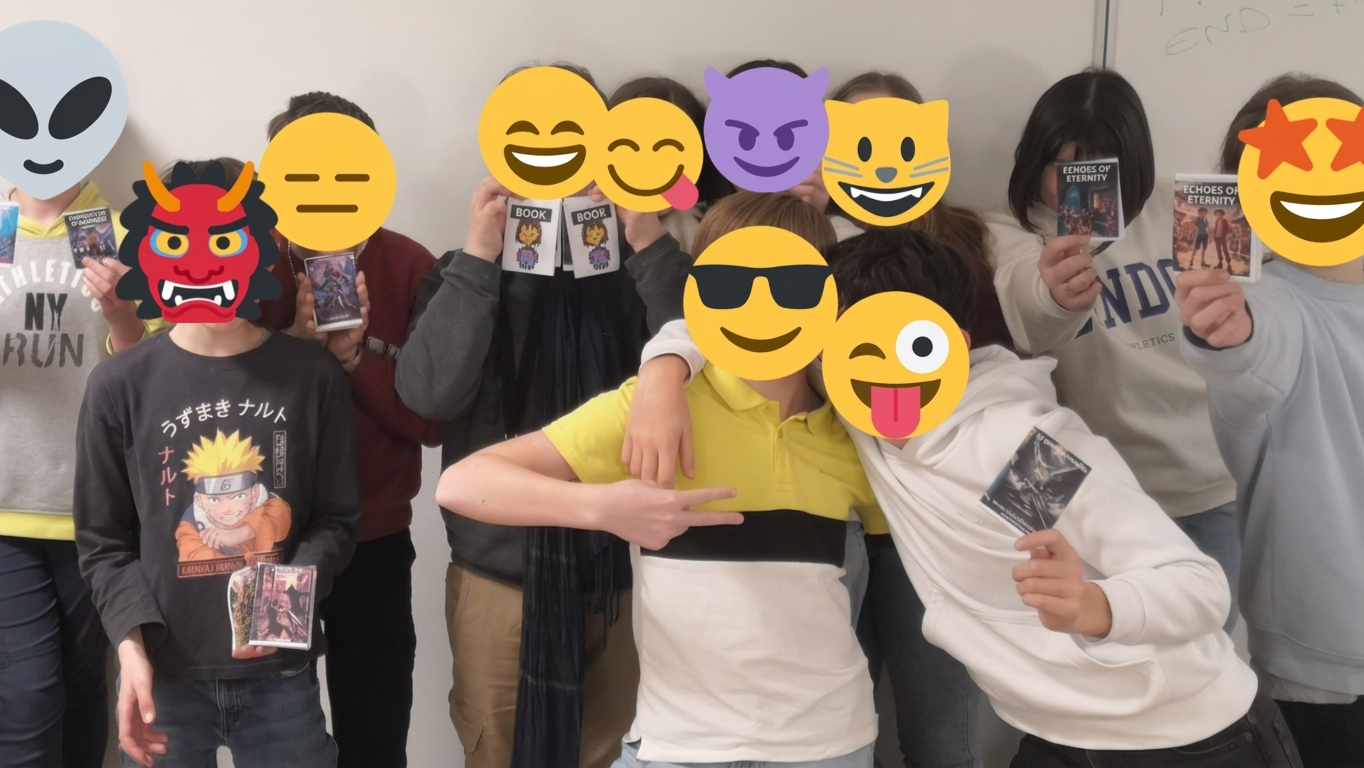
These last few weeks, we experimented in middle school with a digital and media education sequence to raise students’ awareness of AI uses, but also to show them that it can become a tool for learning and creation.
Our objective: to go beyond simple fascination or “wild” use of ChatGPT outside a framework, by offering a truly structured and creative pedagogical framework.
✏️ A sequence centered on fiction writing
The sequence began with a classic task:
- Rediscover what a short story is,
- Explore literary genres,
- Review the story structure: initial situation, plot twists, main character, resolution.
This first step allowed students to reflect on their story project. They chose the genre they wanted to explore (adventure, fantasy, detective, etc.) and imagined the main lines of their plot.
🤖 The AI step: a guided conversation with TokiChat
Once their ideas were laid out, they moved on to TokiChat, in a guided pedagogical conversation.
The AI accompanied them step by step:
- It asked them questions about their characters,
- About the story’s plot twists,
- About the locations, motivations, twists and turns.
By responding, the students clarified and enriched their project. Then, the AI wrote for them a first version of their story.
They then worked on this basis: rereading, comments, corrections, adjustments. The AI allowed for rapid text generation, but above all, for dialogue, testing variants, and refining their scenario.
📖 From writing to the book-object
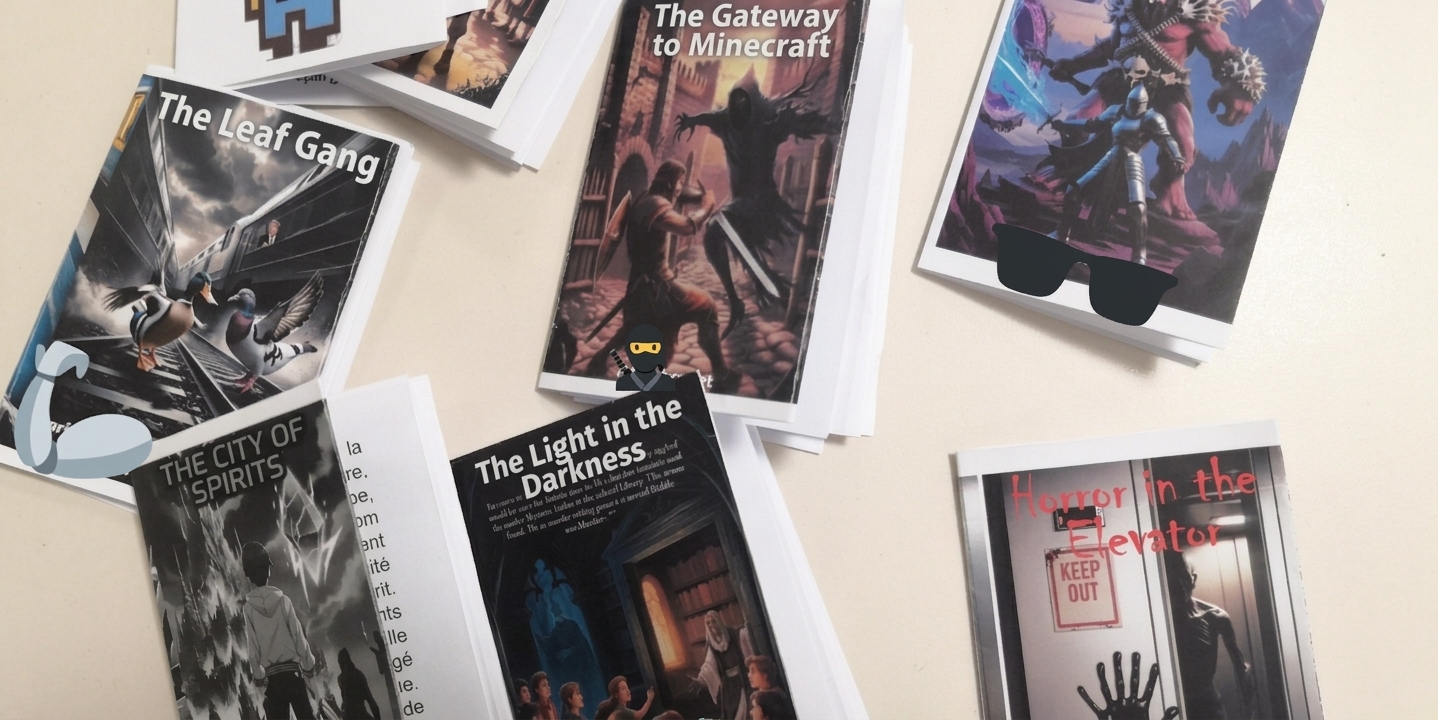
The last step was manual and creative: students laid out their story in the form of a small A4 zine.
- They generated a cover and illustrations using AI tools.
- They printed and folded their booklet.
Result: a real object, which they could share and be proud of. Some even launched their own “saga” by writing several episodes!
🌟 A significant moment
One of the strongest aspects of this experience was inclusion:
- A student usually struggling due to significant dysorthography was able to participate fully.
- With AI, no judgment on mistakes: the model understood his answers and helped him formulate his story like the others.
- He was able to experience the pleasure of writing and inventing without the barrier of spelling.
It is this kind of success that reinforces our idea that a well-designed AI can become a true tool for pedagogical emancipation.
💡 Other pedagogical uses with TokiChat
This project is just one example of what can be done with TokiChat.
The tool was designed to offer guided, structured conversations, adapted to different objectives. Among the possible scenarios:
- Job interview simulation, to work on argumentation and preparation
- Interactive investigation or murder party, where students question suspects and cross-reference clues
- Historical role-playing games to explore periods and points of view
- Supervised debate, with help in formulating arguments
- Remediation or reinforcement exercises for writing
- Exploration of texts or works in question-and-answer mode
- Creative writing activities or guided scenarios for story production
In short: anything that requires writing, formulating, structuring thought can be transformed into an activity with TokiChat.
🎯 Our objective
With TokiChat, we want to offer a clear and practical framework for integrating AI into the classroom, serving pedagogy:
- Not to replace the teacher, but to give them an additional tool,
- To stimulate creativity,
- To differentiate and include,
- To encourage students to dare to write, formulate, question.
We believe that AI can become a true pedagogical partner.